Postcards From Exciting Places

“A thrilling tale of World War II!”

“A spine-tingling adventure to the bottom of the sea!”

“A death-defying trip to outer space!”

All taglines that might catch my attention, yes, especially when I was a kid gobbling up everything I could get my greedy little eyes on.

Almost certainly not coincidentally, these were also the kinds of stories I wanted to write in later years. Yes, I loved classic literature with the symbolism of Moby-Dick, the understated elegance of Hemingway, and the keen social insight of George Orwell.

But I also longed for adventure.

One of the favorite authors in my teen years was thriller writer Alistair MacLean. He wrote using settings like WWII in Where Eagles Dare, a high-wire circus in, well, Circus, and the Arctic in Ice Station Zebra. These places and times fascinated me, and I itched to write my own adventures.

And so I tried to do just that.

A photo of Scottish author Alistair MacLean
Alistair MacLean

When Plot Overshadows Character

For some reason, however, I just could not make the yarns spin out just right. I would either reach the end far too soon, leaving the entire thing feeling flat, or it would simply hit a wall and subsequently die in a dusty drawer or, later, hard drive (also dusty).

This malady went on for years. “Well, maybe I just don’t have it,” I mused, not quite defining what “it” actually was; it just felt comforting to have some sort of excuse for failing.

I would leave off writing for a while and pursue some other interest. But all it took was an encounter with some exciting story, and I would feel the urge to start anew.

Slowly — very slowly, as I admit to not having fully learned this lesson yet — I began to realize what was going wrong.

I was making the story about what it was that had excited me in the first place: the raging battle, the far-flung land, the ancient time.

But those times and places were not what the stories I read were about. They were about the people. And I was neglecting them, in some cases badly so.

The characters in those successful stories were living and breathing, real people with desires, obstacles, relationships, fears, contradictions, and private jokes only they understood. My characters were nothing more than tour guides wearing plot armor, cheerfully pointing at explosions — excuses to write something exciting.

What Makes Adventure Stories Work

Now, there is obviously nothing wrong with those breathtaking settings. I still love them. And it may be what attracts a reader in the first place. But they keep reading for the people, the characters — those hapless creatures struggling through whatever exciting scene has been splashed across the cover.

What makes a World War II story work isn’t the whistling bombs over London or the booming thud of the AA guns. It’s the mother huddled in the dimly lit subway with her child wrapped in her arms as she sings a lullaby and wonders if her husband is still alive somewhere on the battlefield.

What makes a sweeping historical of ancient Rome work isn’t the roaring coliseum and clash of blades. It’s the desperate slave inside the gladiator helmet who knows that freedom is only one more victory away. And who’s starting to wonder if freedom is worth it if everyone he loves will be dead by then.

It’s about the people — the characters — and it always is.

Certainly, character-driven literary efforts live or die by them. But what I didn’t understand (and still often don’t) is that even the most plot-driven thrillers need characters the reader cares about. Because if the reader doesn’t care about the people, they’re not going to care what happens to them.

I thought I was writing adventure stories. Nope, not really. Turns out I was just writing postcards from exciting places and times.

The real adventure is always waiting in the people facing those exciting places and times.
The Other Half of Chekhov’s Gun

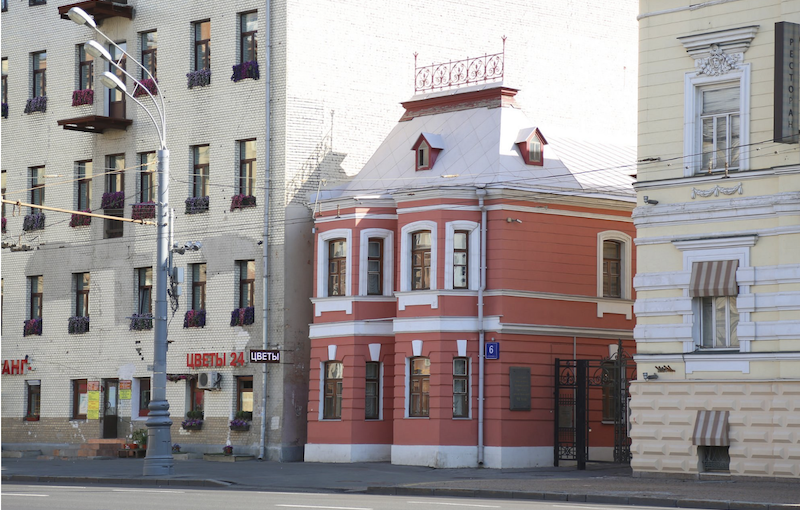
In 1889, on a cold and likely snowy November day in Moscow, Anton Chekhov wrote a letter to Aleksandr S. Lazarev. In his strange little house on Sadovaya-Kudrinskaya Street, possibly while waiting for his next patient, he scrawled,

“One must not put a loaded rifle on the stage if no one is thinking of firing it. It’s wrong to make promises you don’t mean to keep.”

And thus began the popularized literary principle we know as Chekhov’s Gun. Certainly, this general knowledge existed before Chekhov (Greek tragedy, Shakespeare, French neoclassical drama), but there was something about how Chekhov phrased it that made it stick.

Today, we largely think of this principle as an exhortation to writers to keep the promises they make to readers. At the time of that particular letter, however, Chekhov was also concerned with the removal of unnecessary details. In later recollections by others, such as Sergius Shchukin, Chekhov elaborated by saying, “Remove everything that has no relevance to the story.”

In future letters to various recipients, he reiterated these ideas, pushing for economy in storytelling and the full use of whatever remained. But these days, we are mostly left with the distilled idea: If you show a gun hanging on the wall in Act I, it must go off by Act III.

So, while Chekhov did believe that a promise to the reader should be kept, he was also very much in favor of the idea that every important thing must be said, while every unimportant one should be mercilessly cut.

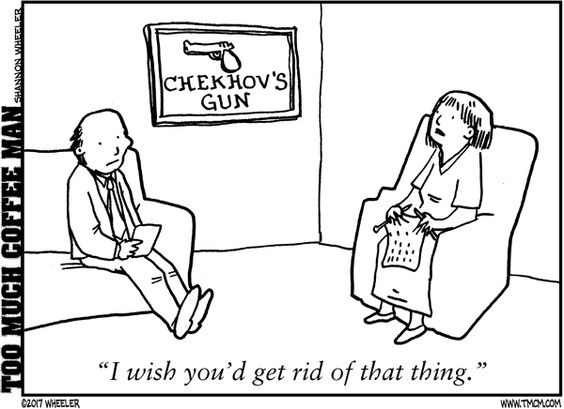
Chekhov's Gun writing principle illustration cartoon

The reasons for the rest of us having kept part of the advice at the expense of the other are many and varied, not the least of which is that literary theory continued developing.

Hemingway, though an admirer of Chekhov’s, did not embrace his creed in toto. Certainly, Papa was a student of minimalism, but he was also a heavyweight champion of the unsaid. Those things left out were not, by default, unimportant. In the 1958 interview in The Paris Review, Hemingway gave an excellent description of his own writing philosophy and, at the same time, further developed Chekhov’s idea:

“…I always try to write on the principle of the iceberg. There is seven-eighths of it underwater for every part that shows.”

So, while Chekhov might have said, “If the gun is on the wall, it must fire,” Hemingway’s version might have gone, “If the gun is on the wall, the reader may never see it fire, but they will feel its weight.”

The original intent behind the gun principle also suffered thanks to the rise of more plot-driven and descriptive literary efforts, which resist cutting all unessential elements simply as a matter of style. After all, the presence of the gun is more memorable than its absence. While certainly not to be elevated to the domain of the masters, the rise of the pulp magazine and the peak of the mass market paperback — which in some ways foretold the kind of binge reading we now see with modern subscription services such as Kindle Unlimited — did not lend to this kind of restraint. And, certainly, current readers are much less interested in parsing through pages to find subtle symbolism than they are in the memorable and immediate.

In short, our current understanding of the gun principle — with its foreshadowing and satisfying payoff — is sexy. Cutting the dross, on the other hand, is the sort of thing that happens in a cold, drafty attic by the light of a single, flickering candle. But it can be argued that a great story needs the principle with both its parts. The fired gun provides the loud report. The ruthless cutting provides the room to let that report echo.

Perhaps the next time we are congratulating ourselves on the loud bang! of a discharging literary firearm, we could also stop and listen for the echo. If it’s not there, if the sound doesn’t reverberate, then maybe we haven’t given it enough room. Instead of asking only, “Did the gun go off,” perhaps we could also ask, “Should that gun have been in the room at all?”

And somewhere in Moscow, on a cold and snowy November day, a certain doctor-playwright will nod, put down his pen, and smile as he rises to answer the timid knock of an arriving patient.